CrimeReports.com – Crime Data In An Easy To Read Format

CrimeReports.com - Crime Map

Crime data is highly sought after information.

Everyone wants to know what crime is like in any given area. As REALTORS®, we’re asked about crime all the time in any given neighborhood. Since we’re not a crime experts, we typically refer our clients to the City Of San Antonio Police Department Crime Data website and from there they can sort through the various data and statistics to figure out what they like or don’t like about a neighborhood.

Unfortunately, most police departments are too busy working on solving and stopping crime to be worried about clean user interfaces and aesthetics in their crime data (although San Antonio has made great strides in making the data more accessible). Enter CrimeReports.com. Using a familiar and simple interface, CrimeReports allows the user to enter the name of the city and bring up a Google Map with an overlay of crime data in that area. With easy to locate icons reporting various types of crime, users can quickly and easily see what’s happening in a given area.

The site also allows you to search through sex offender registries, combining both crime data and sex offender registration sites into one easy to access source.

What is the San Antonio MLS?

Overweb Midori Cluster

The San Antonio MLS

Read any real estate blog and you’ll quickly learn that REALTORS® love acronyms and abbreviations. One you’ll hear more often than not? MLS. Short for multiple listing service, it’s what agents use to help you find a home in San Antonio (or wherever you may live). Simply put, it’s a giant database of homes for sale that is available to REALTORS® in San Antonio.

MLS (or Multiple Listing Service) is a giant list of San Antonio homes for sale at any given moment. While it is one of the most complete databases of San Antonio properties on the market, it is by no means a list of every home for sale. Homeowners may opt out of the system and in San Antonio, the broker must be a member of the San Antonio Board of REALTORS® (not every real estate agent is a REALTOR®). For sale by owners can be listed in the MLS through a brokerage, but they can not do it privately (that’s a complicated enough issue that it deserves its own blog post).

The MLS is one of the REALTORS® greatest tools as it provides updated, accurate (as accurate as it is when it was entered) information on the homes in San Antonio. With it, we can set multiple criteria for your home search, have an email of homes that meet your needs in a matter of minutes, and have the MLS continue to send you properties as they appear on the market or changes are made (such as a price change). Although we’d love to take credit for sending you a list of properties at 4 AM, it’s just the San Antonio MLS doing it’s job (although many agent I know have been known to be up at that hour searching for properties for their clients).

But, I can do all the research online myself…

With the abundance of real estate search sites available to consumers these days, some people think they have no need for the Multiple Listing Service. Although I love the proliferation of technology that has made searching for a home in San Antonio much easier, I have to disagree that the MLS is of no value. The difference is in the data. Many sites such as Trulia, Zillow, and even the search tool right here on this site, rely on one of two ways (or both) of getting their listing data. The first is syndication. New information about listings is pushed out to various sites through data aggregators and appears on thousands of sites at one time. The second way sites get their data is through MLS feeds or IDX (our listings on this site are powered by IDX). Although these feeds provide data about the homes in San Antonio currently for sale, the data is not always updated quickly (causing you to see a home as an active sale, when in fact it has already been sold) and is not as complete as the data available in the San Antonio MLS as many of the aggregators pick and choose what data they share with you on their sites. The IDX we use on this site is updated every fifteen minutes in order to bring you the most up to date information about homes for sale in the MLS.

Don’t be afraid to start your search for a new home online, but be sure to target your search and when it’s time to get a little more serious, contact a local REALTOR® and dive into the world of the San Antonio MLS.

photo courtesy of br1dotcom

Texas Law Library – Looking for the Law?

Capitol Building in Austin, Texas

Where does the law say that?

A visitor to the site once asked me if I happened to know where they could find the statute that makes Texas a non-disclosure state. I didn’t know, but I was curious to know now that someone had asked me. As I’m not a lawyer and can’t cite paragraph and subsection for most laws, I was wondering how I would find this information. I set out on the internet and did some googling and wasn’t coming up with much… until I stumbled across the Texas State Law Library. A free public resource, the Texas Law Library serves both the legal world and the public in their legal research needs.

Pouring through the pages and pages of Texas State Law and searching in vain to find where the non-disclosure status is created, I was starting to get a little lost, so I decided to use the ask a librarian link and see if I’d get a response. Not only did I get a quick response, but Tamsen Conner, a Reference and Electronic Services Librarian at the Texas Law Library, provided me with a link to the exact section of the law that creates the non-disclosure status and also included an interesting article from the St. Mary’s Law Journal that discussed the code in depth. Quick response and very detailed information – thank you Tamsen.

As this post deals with the law, as usual, I must tell you that I am not a lawyer and can not advise you on legal matters. The librarians at the law library are also not lawyers and their correspondence contains a similar disclaimer. If you need legal advice, hire an attorney, but if the laws and statues fascinate you or you need to quote a law for whatever reason, check out the Texas Law Library and be sure to say hello to Tamsen for me.

If you’re wondering where the law was, it is contained in the Tax Code – §22.24(d). Now you know!

image courtesy of rexboggs5

Sharing is caring.

Sharing is Caring

Pass it on…

We share everyday. Websites, funny videos, informative articles…even celebrity gossip. Thanks to social media, sharing is now a normal function of our daily lives. I share things with you, you share my articles with others, we all keep sharing. I’ve even seen cases were other REALTORS® in San Antonio have shared one of my posts in their newsletter (with proper attribution). The real question is, does anyone care about what you share?

Having your posts (or updates or tweets) shared is a great feeling. It gives validation to the author – that they wrote something that was worth telling your friends about. Every time I see any of my stuff shared by someone, I get a little giddy. The thing is, with all this sharing going on, there’s something missing from some of it.

The caring.

When you share something, do you just throw it out there or do you tell your friends, your readers, or your followers why they should care? As more and more people share, dilution becomes a factor. Think of those funny forwards you used to get. Okay, maybe they were never funny, but the first time it was no big deal. The second and third, it was still okay. By the time the forward had circled the globe a few times and you were receiving it from your mom, your dentist, and that kid you never really talked to in middle school, well it was kind of annoying, wasn’t it?

I’d never encourage anyone not to share. What I try and do with each and every share (and I don’t always do it successfully I’ll admit) is tell a bit about why I’m sharing it. In that simple act lies the important part – caring. It shows why I care and tells my readers why they might care. It doesn’t make them care, but it gives them enough info to click that link and decide for themselves.

So next time you share something, whether from your friends or from this site, stop for a second and care about it too. It will make the internet a much more caring place.

Hint, hint – don’t be afraid to use the sharing buttons below to share this article with your friends.

image courtesy of wlodi

Zillow adds new service – Zillow Digs.

Zillow Digs - Home Design Ideas

Home Design Ideas

Zillow recently launched its new service, Zillow Digs, a source for home design and home improvement ideas. Taking a look through the visually focused site, I have to say I was impressed by the mass of activity they’ve already gathered in a short amount of time. The site borrows heavily from Pinterest – see something you like and add (pin, as they say) it to your board, a place where you can collect ideas for your dream home.

Like many new sites and services, there is a social aspect to the site, which lets you share items with your friends and email cool things you find to them as well. Clicking on a photo brings up a detail page where you can leave comments and see the Zillow estimates on what it would cost to build the room for yourself. Much like Zillow Zestimates, these construction cost estimates are based on a Zillow algorithm that Zillow advises should be used as a starting point only.

Zillow Digs also allows you to sort images and projects by tags and various categories such as room and style.

Overall, I like the look and feel of Zillow Digs and I can definitely see people flocking to it as a more home-specific Pinterest-like service. Have you tried it out? What did you think?

screen capture courtesy of Zillow

Zillow takes a new step with the Zestimate.

Step in the Right Direction

Zillow has long been hounded by real estate agents for the inaccuracies of their home valuation model known as the Zestimate. We’ve talked about the unzillowable factor before on the site. Automated home valuation models are often pumped up to be the next big thing in real estate, but so far, they’ve fallen flat and have not lived up to most people’s expectations. But home buyers and sellers are still using them and they’re not going away anytime soon.

The other day, in one of the Facebook groups for real estate I frequent, Jonathan Dalton of All Phoenix Real Estate, pointed out that the Zestimates now come with an additional note that had not previously been there.

A Zestimate® home valuation is Zillow’s estimated market value. It is not an appraisal. Use it as a starting point to determine a home’s value.

The emphasis on the last two sentences is mine and it shows that Zillow is making steps in the right direction to help visitors understand that the Zestimate is not the be all, end all of pricing. In all fairness to Zillow, they have had such disclaimers and wording on their site before, but it was often hard to find.

I still don’t think this will solve every problem with home valuation models, but it is a start. Hopefully sites like Zillow will continue to evolve and help their visitors understand the role we as agents play in the pricing and marketing of homes for sale.

image courtesy of Lachlan Hardy

Home Search Data – How Accurate is the Listing?

Bullseye

A homeowner recently wrote to me asking that we remove their listing from our site as the listing had been cancelled. As always, I looked into the issue, and found that the property had indeed been removed from the market and had been listed by an agent with another company. Checking our home search, I looked for the property and confirmed that it wasn’t on our site any longer. Being curious, I decided to google the property some more and find any other instances of it being listed on the internet. What I found surprised me, but I guess it shouldn’t have.

On this particular listing, I was able to find reference to it on several sites. The listing had been canceled over twelve days earlier, but there it was. I wasn’t too shocked that I found it, listings have a tendency to linger around the internet longer than they should and if the agent doesn’t know the tools they use and how to use them, some listings just seem to last forever and ever. I checked the big sites first, namely Trulia and Zillow. Trulia had the listing, but did correctly note that the listing was no longer active. Zillow listed it, but was ambiguous as to whether it was active or not. I did note that the former listing agent was in the lead spot on the agent ads, which indicated to me that Zillow would still be feeding the leads to that agent. Like I said, this isn’t all that uncommon, it was upon digging further that I found the real surprise.

One of the sites that returned as a search result happened to be the former listing agent’s office website. When I navigated my way to their site, I was presented with a rather unappealing listing page generated by their IDX provider. Much like our home search, the home search was powered by an third party IDX company – there are quite a few out there. The surprise was that the IDX feed showed the property as active. Twelve days after the property was taken off the market, the listing was still for sale according to the site.

Our IDX provider, Diverse Solutions, has been with us since we relaunched this site about a year ago (and before that Matt had used them for personal sites for about three years) and we love their product. It gives our visitors a gorgeous map based home search and is easy to use. What makes it even better? The IDX feed (a stream of data provided by the San Antonio MLS direct to them) is updated every fifeteen minutes. Here was another site that hadn’t been updated in twelve days! Even the hugely popular realtor.com (which has some of the most accurate information of the big sites) doesn’t update that often! Every fifteen minutes our site gets a fresh set of data reflecting new entries into the market, price changes, new info and photos, as well as deleting sold and cancelled listings. It doesn’t get much more up to date than that (unless you use the MLS directly, which only members of SABOR can do).

We’re proud of bringing you this data and promise to continue to stay current with search technology to better your experience on our site. We love having you return day after day looking for that perfect home and thank you for the business generated from this site. Next time you’re thinking about listing your home for sale, don’t be afraid to ask your agent about their technology, accuracy does matter.

image courtesy of seantoyer

Why is my listing on your site?

MLS Listings and IDX

This morning a received an email from a not-so-happy agent from another brokerage. They had found one of their listings on our website and wanted to know how this was possible as they had “not given us permission” nor was it “permitted by SABOR” [SABOR is our local real estate association that owns and operates the MLS]. Of course, I knew why the listing had appeared and knew that neither of these assumptions were true. In fact, the agent had given us permission and it was well within the “MLS Rules and Regulations” of SABOR for us to be showing this property on our website.

Now here’s what bothers me. I’m a nerd, I freely admit that. I tinker and toy with websites and IDX all day long looking for new ways for our company to grow and expand. So yes, I pay attention to these things more than most, but for agents not to understand or be aware of IDX in this day and age is shocking to me. I urge all brokers to sit your agents down and explain it to them, because this is a major component to your business today.

What follows is my response to the agent, edited to remove any reference to their name or their company. Hope you enjoy it (and perhaps those brokers that still haven’t taught their agents about IDX can use it as a teaching aid).

Dear agent, this explains it all.

Hi, my name is Matt and I am the web-nerd for Kimberly Howell Properties. I received your email via our system in reference to your listing at [redacted] informing us that you did not give us permission to post your listing on our site. You also mentioned that SABOR does not approve of it. You found it on our site at the following link: [redacted]

Your property is appearing on our website – www.kimberlyhowell.com – via syndication through IDX (Internet Data Exchange). You may read more about IDX and what opportunities it provides at www.sabor.com/index.php/mls/rules-a-regulations.html (See MLS Rules and Regulations, Page 2, Section 18 – Internet Data Exchange (IDX)). Via IDX, we are able to list and show virtually any property that is listed on the SABOR MLS. Via a contract (provided by SABOR) between us, SABOR, and Diverse Solutions (the company who provides us with our IDX solution), we have the ability and express permission of SABOR to show these listings on our website. SABOR provides the MLS data to Diverse Solutions and they in turn for a fee provide us with the tools to make these listings appear on our website.

There are two main ways for a property to not appear on our website (See MLS Rules and Regulations, Page 2, Section 18.1 – Authorization). One is a blanket refusal of participation in IDX by the broker, which your broker, [redacted], does not have (I know this only because of the amount of properties we have of yours that appear on our site). The other method, is a listing by listing method. This can be done via the MLS during listing data entry. The “Media” tab of the MLS input now contains two drop downs – “Display Listing on Internet” and “Display Address on Internet.” By marking “Display Listing on Internet” as “NO” you would be able to keep your listing off of the internet via IDX (and if I remember correctly all syndication – ie, it won’t appear anywhere). There are also checkboxes for these on the newest version of the Residential Real Estate Listing Agreement Exclusive Right to Sell (TAR-1101, Revision 3-02-12, Page 5, Paragraph 11. Broker’s Authority, Section B). If for some reason you have checked these boxes on your listing, then you will need to speak to SABOR directly about the issue as your data is still being pushed out via IDX.

A quick google search for [redacted] brings back an impressive amount of results (about 1.16 million, although many of these probably can be discounted as there is more than likely more than one [redacted] in the US). You can review the results yourself at: [redacted]

As you can see there are the usual results (the big aggregators – Zillow, Trulia, and REALTOR.com) as well as many small syndicators (movoto.com, homes.com. etc.) and even some brokerages and agent sites (your personalized results will vary but I see [redacted] as one of them). In this case, I’m not even finding us on page one…or the [redacted] site. Because of the dearth of results, I’m going to venture a guess and assume you have not given a refusal to participate via the “Display Listing on Internet” drop down menu in MLS. Of course, this would be the quickest and easiest way to scrub your listing from the internet, although it would still take a few days to really see the effects (SABOR has a minimum requirement of IDX feed updates of every three days – we update a lot more often however).

I hope this helps explain IDX a bit and helps you understand why your property appears on our site. It’s actually a rather common practice and is growing in size every day. We here in San Antonio are a bit behind the curve when it comes to implementing the IDX systems for broker and agent websites if you ask me, but I’m seeing it more and more and I welcome the change. With people using the internet more and more, it makes sense to make properties available on other sites, after all, the goal is to sell the property, and the more people that can view it, the larger the pool of potential buyers.

If there’s anything else I can do to help your understanding of IDX and its uses, please let me know.

I also highly recommend this article by Jay Thomspon (The Phoenix Real Estate Guy) on the subject. Although he is dealing with a different MLS (ARMLS in Arizona), the story is quite the same. Jay is widely regarded by many as the Godfather of Real Estate Blogging and is a highly sought after speaker on the subject (and many others) at many events across the nation.

Your home is not where it should be.

Homes for Sale Map

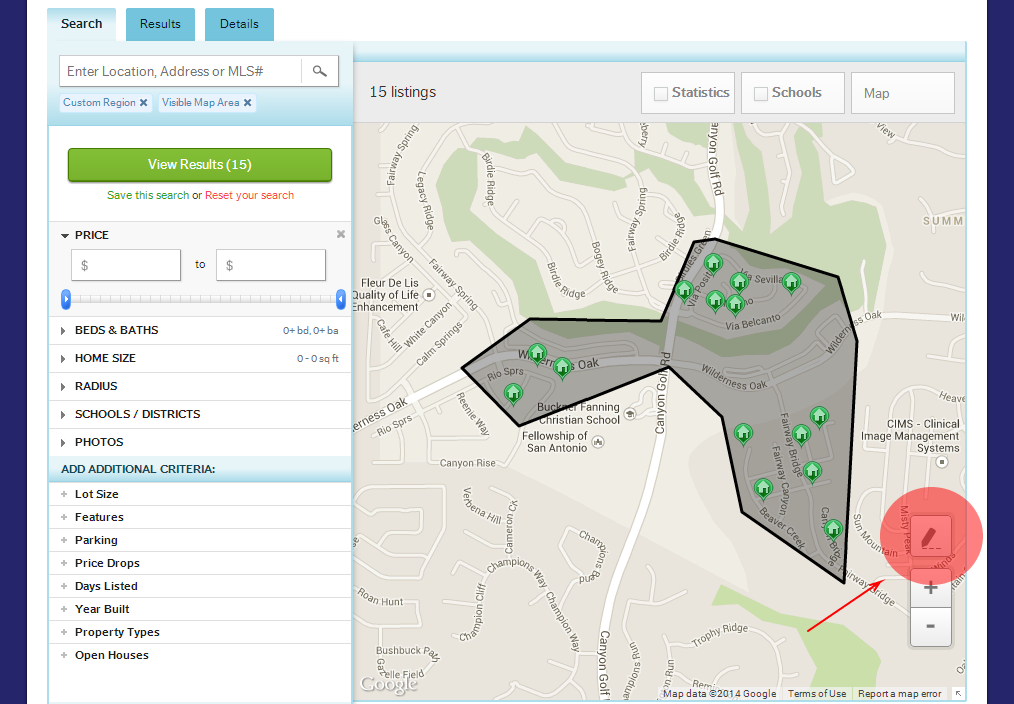
The photo to the left shows a screenshot of a map of homes for sale in The Dominion. As you can see, most of the green icons are clustered together on the map in the right place. But there are a few that seem to be lingering in the large grey area to the east of The Dominion. Right smack dab in the middle of Camp Bullis. I’m going to go out on a limb here and suggest that few people who desire the luxury living of The Dominion want to be located on the firing range of Camp Bullis. So why are these properties showing up here?

The problem typically exists with new home developments, where new streets are being created and Google maps doesn’t have the correct updated data. Sometimes, it’s caused by incorrect data in the maps themselves. Regardless of how it is caused, there are ways to fix it. In the San Antonio MLS, we (as a listing agent) are able to move properties on the map when they are placed incorrectly. With Google and other online map features the addresses can be reported and corrected. If you find your home is not showing correctly on a map, call your agent and let them know. Many searches are done by map these days and having your home in the wrong location can cause your home not showing up in a potential buyer’s search results.

Recently, someone contacted us about their property showing up in our map based search in the wrong location. Unfortunately, there is nothing we could do, as we were not the listing agent for their property. If we had been their listing agent, we would have gotten the problem solved for them, because the accuracy of home data is something we take very seriously.

Like a House? Pin It with Pinterest

Pinterest "Pin It" Button - Pin Your Favorite Properties

Now Pinterest users can pin their favorite homes for sale to their accounts. Using the “Pin It” button located throughout the site at the top of each page or post (note: the button is now located at the bottom of the post), you’ll be able to show your friends and other Pinterest users some of the amazing homes for sale in San Antonio.

In addition to being able to pin photos of our homes, you can post just about any photo to Pinterest, as we’ve left the choice up to you. Clicking on the “Pin It” button will bring up a selection of photos to choose from – we thought we’d give you more choice over which photo you wanted, instead of making only one photo available.

Let us know what you think about this new feature and what types of things you’re posting to Pinterest.

Remodeling your home? Cost vs. Value App for iPhone

iPhone in Clover

As an iPhone user, I’m constantly downloading apps and trying out new tools. A few days ago, I downloaded Remodeling Magazine’s Cost vs. Value app after hearing someone mention it. A free app, Cost vs. Value allows you to compare the average cost for common remodeling projects based on your local area (San Antonio is an included city) and the resale value of the remodeling projects. By knowing the value of your upgrades and projects, you can make better decisions on what upgrades are truly worth it, particularly if you don’t intend to stay in the house for a long time.

So next time you’re thinking of doing a little work around the house, whip out the iPhone and load up the app and see what remodeling project will bring you the most bang for your buck.

image courtesy of MJ/TR (´・ω・)

San Antonio real estate and property information provided by Kimberly Howell Properties. Kimberly Howell Properties does not assume any liability or responsibility for the operation or content of any of the linked resources, nor for any of the interpretations, comments, graphics, or opinions contained therein. All information deemed reliable, but not guaranteed. KJH Properties, Inc. is a licensed real estate brokerage in the State of Texas, Equal Opportunity Employer, and supporter of the Fair Housing Act.